ReserveGauge vs CUStats
ReserveGauge and CUStats are both macOS tools for viewing Claude Code and Codex usage. Choose ReserveGauge if you want a menu-bar workflow, local usage history, reset forecasting and support for Claude Code, Codex, Grok and GitHub Copilot. Choose CUStats if you mainly want a direct Claude and Codex usage view. Both products depend on the provider data they can read, so neither replaces the provider's own account page.
Short answer
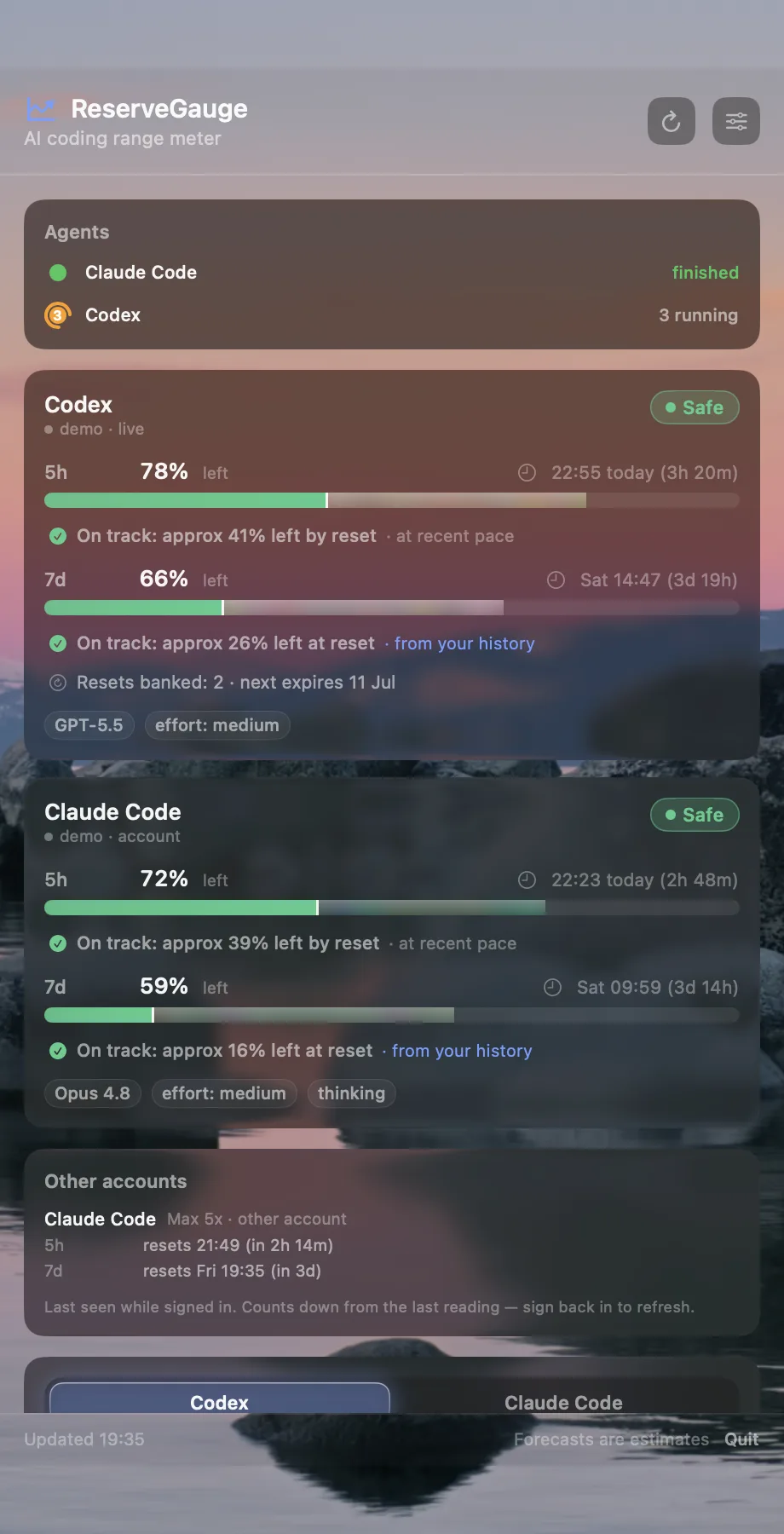
Choose ReserveGauge if you want a private macOS menu-bar app that tracks Claude Code, Codex, Grok and GitHub Copilot, then forecasts whether your current pace gets you to reset. CUStats is also a native macOS tracker, and is worth comparing if you mainly want a direct Claude and Codex usage view.
Feature comparison
| Core use | ReserveGauge: live usage plus forecast-to-reset pacing. CUStats: live Claude and Codex usage tracking. |
|---|---|
| Providers | ReserveGauge: Claude Code, Codex, Grok and GitHub Copilot live today; Cursor planned. CUStats: public materials focus on Claude and Codex. |
| Forecasting | ReserveGauge: projects burn rate from recent history and flags likely run-out points. CUStats: public materials mention pace predictions and history. |
| Privacy model | ReserveGauge: usage history stored locally; provider names, allowance values and usage history are not sent to ReserveGauge. CUStats: public materials describe it as lightweight and private. |
| Install | ReserveGauge: notarised DMG or Homebrew cask. CUStats: macOS app distribution. |
| Pricing | ReserveGauge: free, including forecasts. CUStats: check CUStats directly for current pricing. |
Where ReserveGauge is strongest
ReserveGauge is strongest when you care about the question behind the percentage: will this pace last until reset? The app shows the current allowance, reset time, run-out risk, and forecasted landing point so you can ease off, switch provider, or schedule heavier agent work later.
It also helps if you use more than one coding assistant. Claude Code and Codex are the obvious pair, but Grok and GitHub Copilot limits matter too once they sit in the same daily workflow.
Where CUStats may fit
CUStats may fit if your workflow is mostly Claude and Codex and you prefer its presentation. It is a direct competitor, not a straw man. The right choice is the one that makes your limit state obvious enough that you change behaviour before a task gets cut off.
Useful context
Provider limits change. Anthropic has adjusted Claude Code limits and OpenAI documents Codex usage as part of agentic usage. A tracker should stay useful when the exact limits move, because the real need is visibility, reset timing and pacing.