Claude Code vs Codex usage limits
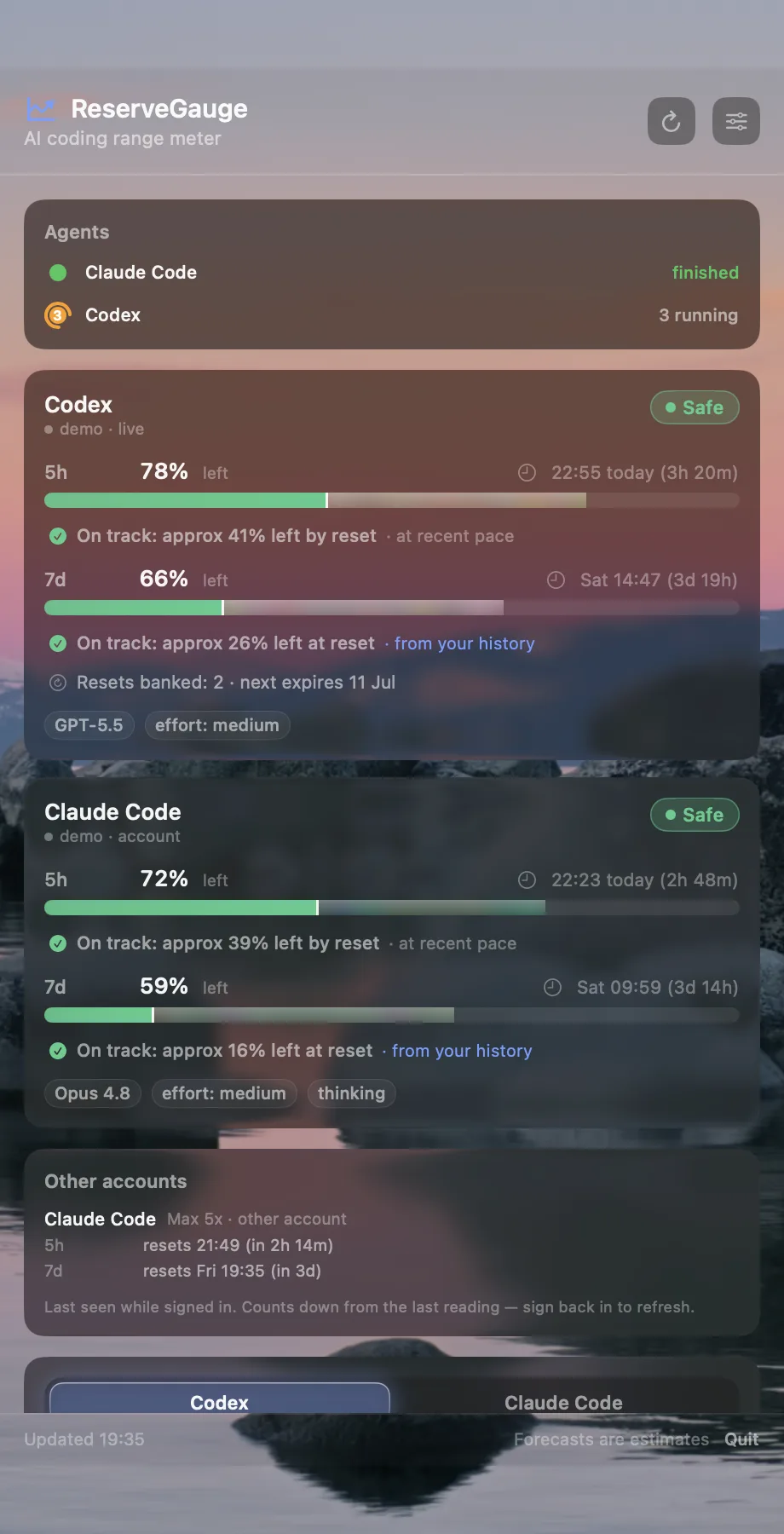
Claude Code and Codex both meter usage, but their windows, account rules and reset details differ. Claude Code commonly exposes a rolling five-hour limit and, on some plans, one or more weekly limits. Codex usage varies by plan, model and task, with a five-hour window and possible weekly limits. The provider dashboard or CLI remains the authority for the current number. ReserveGauge puts both readings in one Mac menu-bar view and uses local history to forecast whether your present pace is likely to reach each reset.
How each one meters usage
Claude Code tracks a rolling 5-hour window and a 7-day (weekly) window. On some plans there's an additional weekly limit specific to Sonnet, tracked on top of the all-models weekly. On Team and Enterprise plans the meaningful limit is a shared pool across the organisation, and a third-party app can only see your individual allocation, not the pooled total.
Codex tracks a rolling short window (around five hours) and a weekly window. Big multi-step agent runs burn the short window fast, while the weekly window quietly governs how much heavy work you can do across the week.
Side by side
| Claude Code | Codex | |
|---|---|---|
| Short window | Rolling 5 hours | Rolling ~5 hours |
| Long window | 7-day weekly (+ separate Sonnet weekly on some plans) | Weekly |
| Reset | Rolls continuously (5h); weekly on a 7-day cycle | Rolling short window; weekly cycle |
| Team/Enterprise | Shared org pool; per-user view only | Per-account |
| What burns it fast | Long sessions, heavy models | Bursty multi-step agent runs |
The shared problem: no forecast
Neither tool tells you whether you'll make it to the reset. They show a current number, but the question that matters is "at my current pace, will I run out before the window resets?" Without a forecast you only find out when a task halts.
In practice
Most people run both: Claude Code for some work, Codex for the rest. The trap is that each has its own short and weekly windows on separate clocks, so you can be comfortable on one and nearly out on the other without noticing. Watching them side by side tells you which one bites first, so you can move the heavy work to whichever has more headroom.
Track and forecast both in one place
ReserveGauge reads your live Codex and Claude Code limits on your Mac, forecasts each from your real usage history, and tells you which one is most at risk, so you can ease off, switch models, or finish the critical part first. Your usage history stays on your Mac; provider names, allowance values and usage history are not sent to ReserveGauge.